

SIBIU HALL
Over the course of more than eight centuries of existence, Sibiu has played an important role not only in the history of the Romanian space but also in that of Central and South-eastern Europe. The vibrant cultural and economic life that brought the city fame in the Middle Ages and the dawn of the modern era is complemented by a rich military history and by the fact that the city has been part of significant historical events, once again underlining its strategic importance in shaping developments that influenced the course of history in this region.
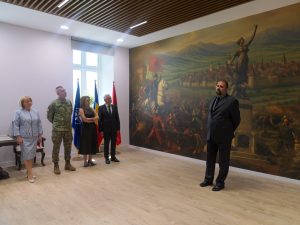
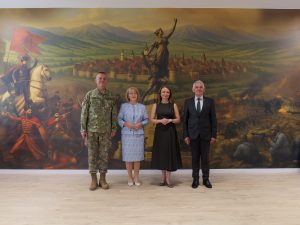
Of the many clashes that took place beneath the city’s walls, two—key moments in Romanian history—are expressively illustrated here through a composition created by combining both classical and modern artistic techniques.
In the background, we see the fortress of Sibiu presented in a timeless dimension, highlighting the fortification system that once made the city nearly impregnable. In the foreground, two battle scenes unfold near the city’s walls.
On the left, we see national hero Michael the Brave during the Battle of Șelimbăr, fought in October 1599 on the plains south of the city. The complex game of Great Powers at the end of the 16th century led the Prince of Wallachia to adopt a bold policy of defending his country’s interests. He proved himself an excellent strategist, a brave warrior, and a skilled diplomat. In this context, Michael’s army reached the outskirts of Sibiu in October 1599 to confront the troops of Prince Cardinal Andrew Báthory. His army included both courtiers and the noble elite from his principality, heirs to medieval martial traditions, as well as professional soldiers, all equipped with weaponry on par with that of Western armies—explaining the military successes achieved until then.
By the end of the day, Michael scored a decisive victory over his adversary, and soon after, the gates of Sibiu were opened to him. In the city, he found trustworthy allies among the local leaders, who supported his victorious army not only financially but also militarily—Sibiu troops even taking part in future campaigns.
The Battle of Șelimbăr holds special significance in Romanian history. The victory paved the way for Michael’s entry into Alba Iulia, the capital of the Principality of Transylvania, marking a major step toward the first political unification of the Romanian territories. This process was completed in 1600 when Michael also entered Moldavia and took control of the principality. For the first time, the three historical provinces that make up today’s Romania had a de facto single ruler—one who could rightfully proclaim himself, “by the grace of God, Prince of Wallachia, Transylvania, and all of Moldavia.” Though his dream of long-term unity was cut short by unfavourable circumstances, Michael’s epic remains a brilliant chapter in Romanian history.
The struggle to unite Romanian territories continued 300 years later, with Sibiu once again playing a central role in major historical developments. On the right side of the artwork, the last battle of Sibiu is depicted. In 1916, Europe had been ravaged for two years by a conflict unlike any seen before—World War I, or the Great War as it was known then—fought between two major military alliances: the Entente and the Central Powers.
In the summer of 1916, Romania entered the war on the side of the Entente, with the specific aim of uniting Transylvania with the national territory. In August 1916, the Romanian First Army, under General Ioan Culcer, launched a major offensive through the Olt Valley, with Sibiu as a key objective. Troops led in the field by General Ioan Popovici reached the city at the end of August following several successful engagements with enemy forces.
In early September, violent battles took place in Șelimbăr—on the same field where Michael the Brave had fought three centuries earlier. This marked the beginning of what would become known as the Battle of Sibiu. Intense fighting also took place in nearby localities, traces of which remain visible to this day. By mid-September, experienced troops of the Central Powers, battle-hardened from the Western Front, were brought in to counter the Romanian advance.
The Central Powers’ command in Sibiu was taken over by none other than the former Chief of the German Imperial General Staff—proof of how seriously the Romanian offensive in southern Transylvania was regarded. Between 26 and 29 September, the decisive phase of the Battle of Sibiu unfolded, marked by a strong counteroffensive by German and Austro-Hungarian troops, met with fierce Romanian resistance.
The bloody confrontations involved shock troops, cavalry, heavy artillery, military aviation, machine guns, and trench warfare. The front stretched over approximately 80 kilometres around Sibiu. Ultimately, the experience of the elite Central Powers troops turned the tide. The Romanian Army lost its positions around Sibiu and was forced to retreat, narrowly avoiding encirclement and thus thwarting the enemy’s plans to destroy the Romanian forces. The bravery and fighting spirit of the Romanian soldiers were acknowledged even by the enemy, as evidenced by contemporary accounts.
Thus ended the last of the great battles fought near Sibiu. From the suffering and sacrifice of Romanian soldiers in the first year of World War I would rise the victories of 1917, and ultimately, the historic act of December 1st, 1918, which marked the birth of Greater Romania.
A symbol of the long and sacrifice-filled road to national unification, and of those who gave their lives during the Great War, stands at the centre of the composition, dividing the two battle scenes: an impressive commemorative statue known as “The Winged Victory.” Though familiar to many in Sibiu, it has been somewhat unjustly forgotten.
Plans for this monument began in 1919, right after the last major battles involving the Romanian army. The gesture of honouring fallen heroes was all the more fitting as Sibiu became a key military hub. In 1920, by royal decree, Infantry Military School No. 2 was founded here—an elite institution for training future officers.
The initiative to build the monument came from the school itself, through a public fundraising campaign. Its first commander, Colonel Christea Vasilescu—a Great War veteran—led the project. Soon, with the necessary funds raised, implementation began, resulting in a monument that exceeded expectations.
The pedestal is decorated with bas-reliefs showing battle scenes, military symbols, and the inscription “Monument to the officers who sacrificed themselves for the unification of the Nation.” The base supports a large bronze sculpture: a female figure—symbolizing the victorious homeland—with her left hand raised in tribute to the country’s heroes, and a wounded soldier kneeling at her feet, struck by enemy fire.
The monument was inaugurated in 1926 in the presence of King Ferdinand and other distinguished guests, including Prince Nicholas, Minister of War General Ludovic Mircescu, General Constantin Prezan (a war hero and future Marshal of Romania), Metropolitan Nicolae Bălan of Transylvania, and Generals Henri Cihoski and Nicolae Petală. Thousands of citizens from across the county attended the event.
With this, Sibiu enriched its heritage with one of the most valuable commemorative monuments in the country, highlighting its importance in shaping recent history.
The female figure in the statue looks confidently forward—over the battlefield scene and, we imagine, over the challenges of the 20th century—into our own era. Today, Sibiu retains and enhances its role as a dynamic development hub, a cultural, academic, and military centre, part of a European Romania and a vital contributor to the concert of modern democratic nations.